

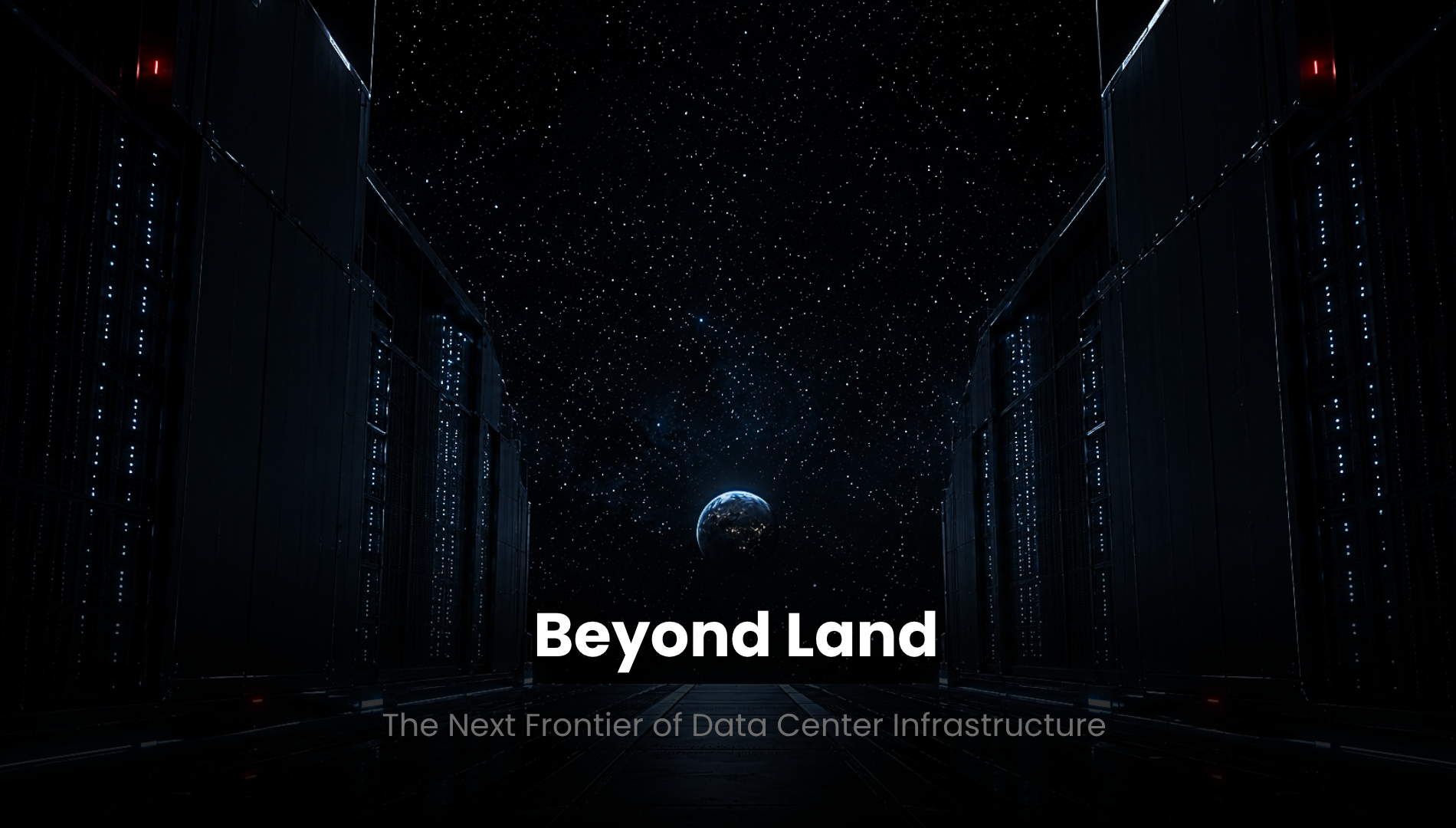
Land is no longer the only constraint shaping where data centers can be built. Rising demand for power, water, connectivity, and regulatory approval is forcing governments and developers to reconsider how and where computing infrastructure is deployed.
So, what happens if those constraints continue to intensify? Where will the next generation of computing infrastructure be located?
As the global race for data infrastructure continues with the rapid adoption of AI, governments and technology companies are exploring alternative approaches to address long-term infrastructure challenges, including underwater and space-based data centers.
These aren’t necessarily predictions about where most data centers will eventually be built. They’re examples of how the industry is beginning to rethink the physical assumptions behind computing infrastructure and how infrastructure planners respond when conventional infrastructure becomes increasingly constrained.
Why Traditional Data Center Growth is Becoming More Difficult
Electricity is becoming one of the major constraints for traditional data center growth. According to the IEA’s 2025 Energy and AI analysis report, global data center electricity consumption was estimated at about 415 terawatt-hours (TWh) in 2024. The IEA projects that this amount will more than double to around 945 TWh by 2030.
As AI demand grows, data centers require access to even more substantial and reliable power supplies. That can make grid capacity and interconnection timelines just as important to a project as the physical availability of land.
In addition to electricity, large facilities can also require significant water for cooling, while suitable sites may face permitting restrictions or opposition from surrounding communities. Even where land is available, the infrastructure needed to connect a facility to power and telecommunication networks may not be.
These pressures don’t necessarily make conventional data centers unfeasible. However, they do make location and infrastructure design more strategic. For developers, governments, and investors, the question becomes whether alternative approaches can remove some of these constraints without creating more difficult ones elsewhere.
New Frontiers in Data Center Infrastructure
There are several emerging concepts that technology companies and infrastructure developers are exploring to expand digital infrastructure while avoiding constraints tied to traditional data centers.
Underwater Data Centers
Underwater facilities are no longer purely experimental. In China, a 24-megawatt underwater data center off Shanghai began operating in May 2026, combining subsea cooling with power from a nearby
offshore wind farm. The project shows how underwater infrastructure could combine natural cooling with nearby renewable energy.
However, the model also introduces new considerations, from maintenance and marine infrastructure to potential environmental effects. According to The Guardian, researchers have raised questions around localized seawater heating and sediment disturbance, which experts say were most likely manageable but may need further monitoring.
Space-based Data Centers
Space-based data centers represent a more speculative frontier. SpaceX and Blue Origin have explored placing AI computing facilities in orbit. Their appeal comes from access to abundant solar energy and fewer land and water constraints, but major challenges remain, including launch costs, cooling in space, radiation, maintenance, and data transfer.
Offshore Floating Facilities
Floating facilities offer another alternative to land-based construction, potentially creating sites at sea while bringing computing infrastructure closer to offshore energy resources.
That concept is already being explored by industrial players. Samsung Heavy Industries and Mousterian Corporation have signed an engineering agreement for their first floating data center project planned for deployment in Texas. The proposed facility would provide 50 MW of IT capacity and have its own cooling system to avoid depending on potable water supplies.
However, moving infrastructure onto water doesn’t completely remove the underlying infrastructure constraints. The Texas project would still need access to reliable power and regulatory approval, while marine environments introduce their own engineering and operational challenges. The project illustrates how alternative data center locations may reduce pressure on one resource while creating new dependencies elsewhere.
Experimental Cooling Systems
Location isn’t the only variable being reconsidered. Researchers and startups are also looking into whether the cooling systems inside conventional data centers can be redesigned to use less power and water.
One example is a nuclear-inspired liquid-cooling system being developed by Ferveret, a startup founded by MIT researchers. According to MIT News, the system is designed to operate without water, and a study conducted with UCLA researchers found a 15% improvement in computational power efficiency compared with state-of-the-art liquid cooling systems.
Such efficiency gains could reduce the resources required per unit of computing and could expand the number of locations where data centers can operate economically.
The Business Behind the Infrastructure Race
Aside from experimenting with alternative infrastructure models, the other question is how much capacity the digital economy will actually need.
Data center development needs substantial upfront capital, and projects can take years to plan, permit, connect to power, and build. That creates a challenging investment situation where leaders must make long-term infrastructure decisions based on forecasts of demand that can change much faster than the facilities themselves.
Companies continue investing in infrastructure despite uncertain returns because AI has intensified competition for scarce power and suitable sites. Securing these early provides a competitive advantage when capacity is constrained. Governments may also see data center investment as a way to strengthen digital infrastructure and attract technology-related economic activity.
However, building early can come with its own risk. The infrastructure may last for decades, while chip efficiency, utilization rates, models, and workloads can change much faster.
The Risk of Overbuilding
The scale of today’s data center construction raises a natural question: could the industry eventually build more capacity than the market needs?
McKinsey’s July 2026 analysis suggests the answer is more nuanced than a simple overbuilding scenario. It found that the U.S. large-load interconnection requests were roughly nine times the data center demand projected for 2030 in its continued-momentum scenario.
That gap doesn’t necessarily indicate nine times as much capacity will be built. Developers may submit multiple or speculative requests to secure scarce power, meaning interconnection pipelines can substantially overstate eventual demand.
The possibility of weaker AI demand in the future doesn’t automatically make all supporting infrastructure obsolete either. McKinsey notes that even if data center demand falls short, generation and transmission assets constructed to support it could still serve broader power demands.
For investors and governments, the more immediate concern may not be overbuilding in absolute terms, but committing capital to projects before their demand, location, and long-term economics have been clearly determined.
Quantum Computing and Other Emerging Technologies
Quantum computing is one possible long-term factor that could reshape infrastructure demand. According to IBM, quantum computing is a developing field of computer science and engineering that uses the unique qualities of quantum mechanics to develop computers capable of solving certain problems that classical supercomputers can’t solve efficiently.
Widespread adoption remains uncertain, but quantum systems have different requirements from conventional AI and high-performance computing. This brings into question how they could eventually fit into data center environments.
While quantum computing is an emerging technology that could affect infrastructure demand, it probably won’t simply replace AI data centers altogether. Open Compute Project’s published guidance explores integrating quantum computers into data centers as accelerator-class resources alongside AI and high-performance computing infrastructure, including their cooling, networking, control, and facility
requirements. Quantum systems may therefore become another specialized computing resource that data centers have to accommodate.
More efficient AI models, edge computing, and specialized hardware could similarly change future requirements for centralized infrastructure.
For infrastructure investors, the implication isn’t that one technology will inevitably replace another, but that long-lived facilities need enough flexibility to accommodate technologies that may not yet be commercially adopted.
Governments, Investors, and Strategic Infrastructure
Governments and investors are making infrastructure decisions that will remain in place long after current technology changes. The challenge is to balance national competitiveness and private investment with public incentives, infrastructure resilience, and adaptability. Because demand and computing technologies can change significantly over an asset’s lifetime, flexibility should be treated as an investment consideration rather than an afterthought.
Emerging Markets and the Next Opportunity
Emerging markets don’t need to replicate the infrastructure strategies of mature data center markets. They can prioritize power-ready locations, strong connectivity, supportive policy, and facilities that can expand in phases as demand materializes. The goal is to attract investment and remain competitive without developing assets that depend on short-lived demand assumptions.
Looking Ahead
In the past, building more capacity was the priority. But for the future of AI infrastructure, adaptability may become the differentiator. The advantage may lie in building infrastructure that can remain useful as technology changes and not simply in building the most capacity.
Conclusion
The future of digital infrastructure extends beyond constructing additional facilities. Success will depend on balancing innovation with investment discipline. Long-term competitiveness will increasingly rely on technological flexibility and strategic planning to keep up with a rapidly changing global environment.